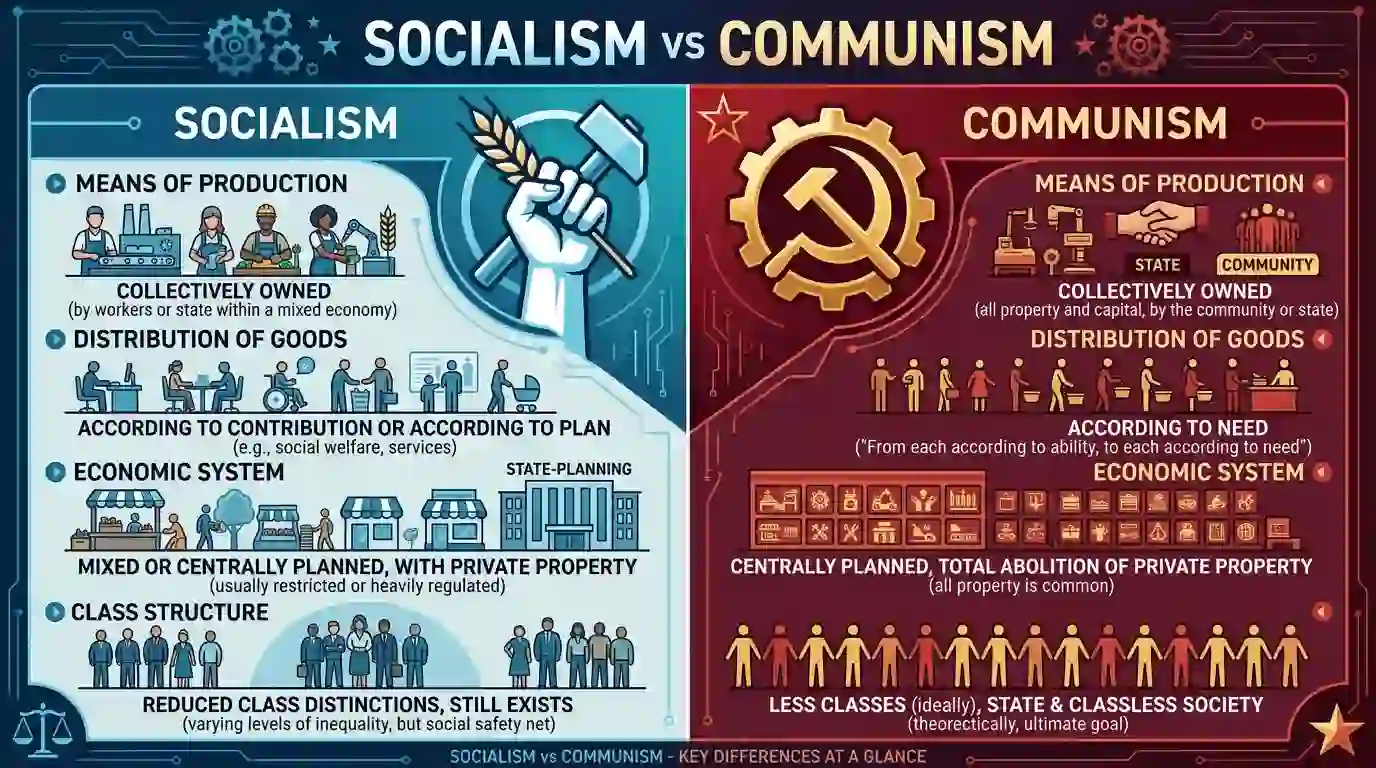
Socialism and communism both seek greater collective control over economic resources, but they are not identical. Socialism is a broad family of ideas that can support public or worker ownership while allowing markets, private property, or democratic institutions. Communism, in its classical Marxist form, aims for common ownership, a classless society, and eventually a society without a state or economic classes.
Key Takeaways
- Socialism is a broad political and economic tradition, not one single system.
- Communism is a more specific tradition associated especially with Marxism and the goal of a classless society.
- Some forms of socialism allow private property and markets, while full communist theory seeks common ownership of productive resources.
- Democratic socialism is not automatically the same as communism.
- Countries commonly described as communist have historically operated through states and political systems that do not represent Marx’s theoretical end-state of stateless communism.
What Is Socialism?
Socialism is a broad set of political and economic ideas centered on social, public, or collective control of the means of production. The means of production include major resources and organizations used to produce goods and services, such as factories, infrastructure, and large enterprises.
There is no single version of socialism. Some socialists favor government ownership of major industries. Others favor worker-owned businesses, cooperatives, or democratic control of economic institutions. Some forms can also operate alongside markets and private businesses.
That variety matters because calling every socialist system a centrally planned economy creates an inaccurate picture. The Stanford Encyclopedia of Philosophy describes socialism as a broad tradition containing many different theories and approaches.
Socialism generally focuses on reducing economic inequality and giving workers or society greater control over economic decisions. Different socialist traditions disagree about how much government should control, how markets should work, and how quickly capitalism should be replaced.
Different Forms of Socialism
Two terms often cause confusion in the United States: democratic socialism and social democracy.
Democratic socialism generally seeks a socialist economy through democratic political institutions. Social democracy, by contrast, usually retains capitalism while using taxes, regulation, public services, and social programs to reduce inequality.
That means a country can have a large welfare state without being a socialist economy in the strict sense.
What Is Communism?
Communism is a political and economic tradition that seeks a society based on common ownership and the elimination of economic class divisions.
Karl Marx and Friedrich Engels became the most influential thinkers associated with modern communism. Their ideas developed during the 19th century, when industrialization produced major changes in work, wealth, and social class.
In the classical communist ideal, productive resources would no longer be privately controlled by a capitalist class. A fully developed communist society would also be classless and, in Marx’s theory, eventually stateless.
Marx’s Critique of the Gotha Programme describes a higher phase of communist society in which distribution would follow the principle of providing according to people’s needs rather than simply according to their individual contribution.
This is important because communism as a theoretical goal is not identical to the governments that historically called themselves communist.
Socialism vs Communism: Key Differences
The easiest way to understand socialism vs communism is to compare their ideas about ownership, markets, distribution, government, and political change.
| Feature | Socialism | Communism |
|---|---|---|
| Basic idea | Social or collective control of major economic resources | Common ownership and a classless society |
| Private property | May allow some private property, depending on the form | Classical theory seeks to eliminate private ownership of productive property |
| Markets | Some forms allow markets | Classical communist theory aims to replace capitalist market production |
| Economic classes | May remain, although inequality is reduced | Seeks a classless society |
| Distribution | Often connected to contribution and social provision | Fully developed theory emphasizes distribution according to need |
| State | May use a government to manage or regulate the economy | Full communist theory envisions the eventual disappearance of the state |
| Political methods | Can include elections and democratic reforms | Marxist-Leninist movements historically emphasized revolutionary transformation |
Ownership and Private Property
One of the biggest differences concerns what society owns collectively.
Socialism can involve public ownership of important industries while still permitting private businesses, personal possessions, or other forms of private ownership.
Communism, in its classical form, goes further. It seeks common ownership of the means of production and the elimination of the capitalist ownership structure that creates separate economic classes.
A useful distinction is between personal possessions and private ownership of productive assets. Saying communist theory abolishes private property does not simply mean that people cannot own clothes, books, or everyday personal items.
Markets and Economic Planning
Some socialist systems or theories permit markets. Others favor extensive economic planning.
Communist theory traditionally rejects capitalist production organized primarily around private profit and instead imagines production organized around collective needs.
However, real-world economies rarely fit perfectly into one box. Even countries that identify with socialist or communist traditions have used different combinations of state ownership, markets, private businesses, and economic planning.
Distribution of Wealth
Socialist systems can use taxes, wages, public services, social programs, or collective ownership to distribute resources more equally.
In Marx’s discussion of the emerging communist society, distribution initially remains connected to individual labor. In the higher phase of communist society, Marx describes distribution according to need.
This distinction is one reason the simple statement “socialism distributes according to work while communism distributes according to need” can be useful as a starting point but should not be treated as a complete definition of every socialist tradition.
Government and the State
Another important difference concerns the long-term role of government.
Socialism does not necessarily require the abolition of the state. Many socialist theories use democratic government to organize public ownership, regulate markets, provide services, or redistribute resources.
In Marx’s mature theoretical framework, however, a fully developed communist society would eventually become stateless because the class conflicts that required a political state would no longer exist.
This is different from the historical experience of communist states, which generally had powerful governments rather than no government.
Democracy and Political Change
Socialism does not automatically require revolution or authoritarian government. Socialist movements have included democratic, parliamentary, revolutionary, anarchist, and other traditions.
In the United States, socialist political movements have historically participated in elections. Eugene V. Debs, one of the most prominent American socialist leaders, ran for president five times on the Socialist ticket.
Communist movements have also differed across time and place, but Marxist-Leninist revolutions became particularly influential during the 20th century.
Therefore, saying that all socialists favor gradual reform and all communists favor revolution is too broad. The historical record is more complicated.
Socialism and Communism: Similarities
Despite their differences, socialism and communism share important roots.
Both developed partly from criticism of capitalism and concentrated economic power. Both have traditions that emphasize workers, economic equality, and collective control of productive resources.
Karl Marx is particularly important because his writings influenced both socialist and communist movements. However, the relationship between the two terms has changed over time.
The distinction commonly taught today, in which socialism represents a transitional stage and communism represents the higher end-state, became especially influential in later Marxist traditions. The Internet Encyclopedia of Philosophy notes that Marxist thought distinguishes a lower and higher phase of post-capitalist society.
At the same time, Marx and Engels did not always use the words “socialism” and “communism” in the rigid way many modern summaries suggest. This historical nuance helps explain why definitions sometimes differ.
Socialism vs Communism in the United States
In American political discussions, socialism vs communism often has a meaning that differs from academic discussions of political theory.
The United States has a predominantly capitalist economy, but it also has government programs and publicly provided services. The existence of one public program does not automatically make an entire economy socialist.
The history of American socialism also goes back more than a century. Eugene Debs became one of the country’s best-known socialist political figures, and his 1912 presidential campaign received about 6 percent of the popular vote.
Today, Americans may use “socialism” to describe several different ideas, including public healthcare, stronger labor protections, wealth redistribution, democratic ownership, or government ownership of certain industries. Those ideas are not necessarily identical.
Democratic Socialism vs Social Democracy
This distinction is especially useful.
Democratic socialism generally seeks to move beyond capitalism toward greater social or democratic ownership of the economy while maintaining democratic political institutions.
Social democracy generally accepts a market-based capitalist economy but seeks to make it more equal through taxation, regulation, labor protections, and public services.
So a country with universal healthcare and strong social programs is not automatically communist, and it is not necessarily socialist in the strict economic sense either.
What About Countries Called Socialist or Communist?
The labels used by governments can create additional confusion.
Several modern governments are governed by communist parties or officially describe their political systems using socialist or communist terminology. However, none represents the fully developed, stateless communist society described in classical Marxist theory.
For example, the Soviet Union had a powerful state rather than the stateless society envisioned as the long-term communist ideal. History.com similarly notes that no country has achieved a purely communist society as described by communist theory.
The same principle applies when discussing “socialist countries.” Countries often described as socialist may actually combine public programs, government regulation, private ownership, and market activity.
Is Socialism the Same as Communism?
No. Socialism and communism overlap, but they are not interchangeable terms.
Socialism is the broader category and includes many different approaches to economic ownership and equality. Communism is a more specific tradition that, in its classical Marxist form, seeks common ownership, the elimination of economic classes, and eventually a stateless society.
The simplest way to remember the distinction is:
Socialism asks how society can give people greater collective control over economic resources. Communism, in its classical form, describes a much more complete transformation toward common ownership and a classless, eventually stateless society.
Frequently Asked Questions
Is communism a form of socialism?
Communism is historically connected to the socialist tradition and is often treated as a branch or development of socialist thought. However, the exact relationship depends on the definition being used. In later Marxist theory, socialism is often described as the earlier phase leading toward communism.
Does socialism allow private property?
Some forms of socialism allow private property and private businesses, while others seek much broader collective ownership. The term “socialism” covers several different traditions, so it is inaccurate to assume that every socialist system has identical property rules.
Does communism allow private property?
Classical communist theory seeks to eliminate private ownership of the means of production. That is different from saying that people cannot have personal possessions. The important distinction concerns productive property and the capitalist ownership relationship.
Is democratic socialism the same as communism?
No. Democratic socialism generally emphasizes democratic political institutions and seeks greater social or worker control of the economy. Communism, particularly in its Marxist-Leninist historical forms, has often been associated with revolutionary political movements and one-party states. The two should not be treated as synonyms.
Is the United States socialist or communist?
The United States is generally classified as a capitalist mixed economy, not a socialist or communist economy. It combines private ownership and markets with government regulation, public programs, and some publicly owned institutions.
Conclusion
Understanding socialism vs communism requires more than saying that one is “less extreme” than the other. Socialism is a broad family of ideas with many different approaches to ownership, markets, democracy, and economic equality. Communism is a more specific tradition, especially associated with Marxist theory and the goal of a classless society based on common ownership.
The biggest source of confusion is the difference between theoretical communism and historical communist states. A government that calls itself communist does not necessarily represent the stateless and classless society envisioned in classical theory. Likewise, a country with strong social programs is not automatically socialist.
The clearest comparison is therefore about ownership, markets, distribution, political institutions, and the intended end-state, rather than simply attaching a label to a country or political party.