Sometimes, you simply do not know what to say. Maybe you are unsure, confused, or just want to say, “I have no idea.” That is where the shrug emoji comes in.
Imagine a friend asking you, “Why is the internet so slow today?” You could type a long answer, or simply reply, “🤷.” One tiny emoji can say it all.
The shrug emoji is casual, expressive, and easy to use. It can show uncertainty, confusion, indifference, or a playful “What can I do?” feeling. On social media, it also adds personality to captions, comments, stories, and messages.
Whether you want to understand 🤷, copy it quickly, create aesthetic emoji combinations, or learn how people use it online in 2026, this guide has you covered.
What does shrug emoji mean?
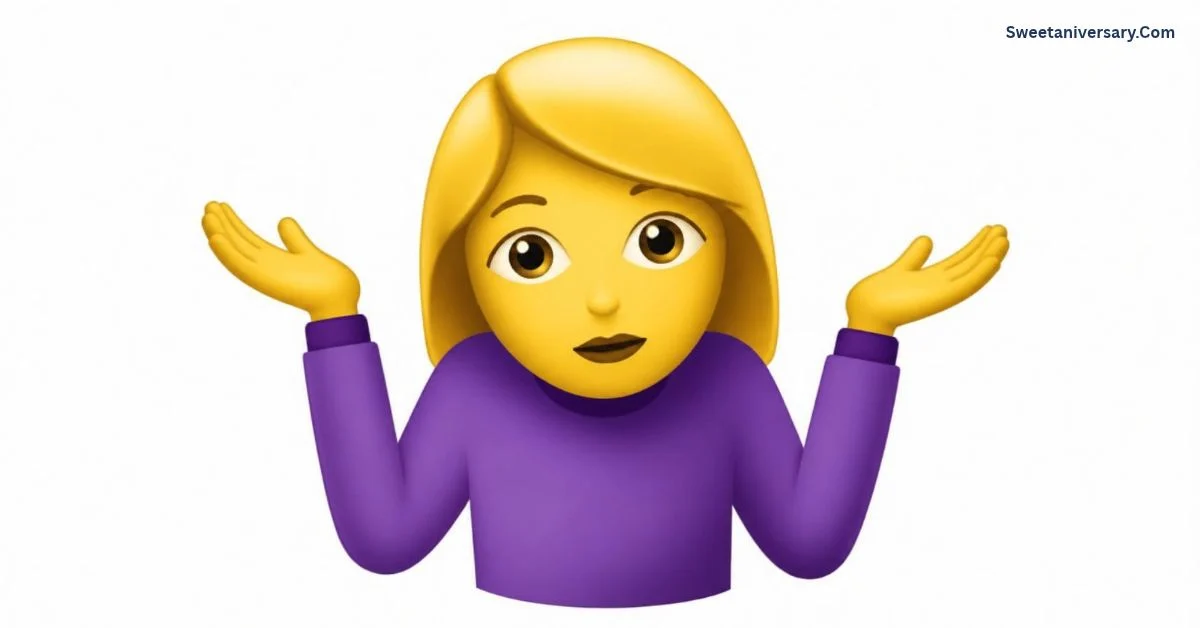
The shrug emoji 🤷 usually means “I don’t know,” “I’m not sure,” or “What can I do?”
The emoji shows a person raising their shoulders with their palms facing upward. This body language is often used when someone does not have an answer or does not know what will happen.
Its meaning can change slightly depending on the conversation.
Common meanings of 🤷
- I don’t know.
- I’m not sure.
- I have no idea.
- What can I do?
- Who knows?
- It is what it is.
- I’m confused.
- I don’t have an answer.
- Maybe.
- I’m not responsible for that.
- Whatever happens, happens.
- I have nothing to say.
For example:
Friend: “Do you know when the movie starts?”
You: “🤷”
Here, the emoji simply means “I don’t know.”
But the same emoji can have a playful meaning:
Friend: “Why did you buy another pair of shoes?”
You: “🤷😂”
In this case, it can mean, “I don’t know, I just wanted them!”
🤷 vs 🤦
These two emojis are easy to confuse.
| Emoji | Common meaning |
|---|---|
| 🤷 | Uncertainty, not knowing, indifference |
| 🤦 | Frustration, embarrassment, or disbelief |
If you want to say “I don’t know,” 🤷 is usually the better choice.
If you want to say “I can’t believe this,” 🤦 may fit better.
What does 🤷 mean in texting?
In texting, 🤷 is often a quick response to uncertainty.
Examples:
- “Are we still going out tonight?” — 🤷
- “Who told him that?” — 🤷
- “Do you think she’ll come?” — 🤷♀️
- “Why did the plan change?” — 🤷♂️
It keeps the conversation relaxed without making the response sound too serious.
How to use shrug emojis
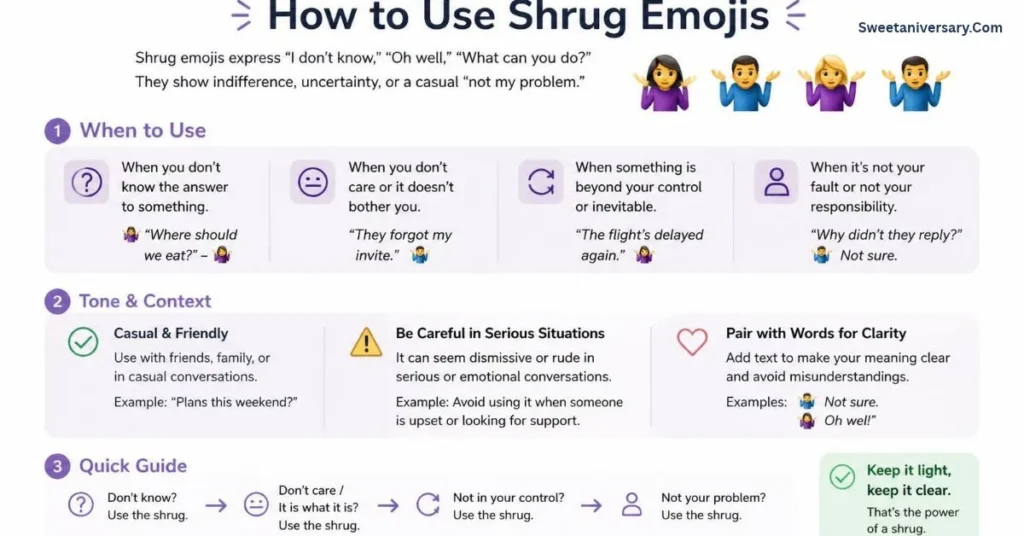
The shrug emoji works best in casual conversations, social posts, comments, and friendly chats.
You can use it alone or combine it with words and other emojis.
1. Use 🤷 when you don’t know
“I honestly don’t know 🤷”
This is one of the most natural uses.
2. Use it for uncertainty
“Maybe we’ll go tomorrow 🤷”
Here, 🤷 shows that you are unsure.
3. Use it playfully
“I ate the last slice 🤷😂”
The emoji can make a statement feel less serious and more humorous.
4. Use it with “who knows?”
“Who knows what happens next? 🤷”
This gives your message a relaxed tone.
5. Use it when something is outside your control
“The weather changed again 🤷♀️”
The emoji can communicate a feeling of acceptance.
Real-life texting examples
When plans change:
“Looks like the party is canceled 🤷”
When someone asks a difficult question:
“Honestly, I have no clue 🤷”
When joking with a friend:
“Was I supposed to save you some pizza? 🤷😂”
When you are unsure:
“Maybe I’ll join later 🤷”
When accepting something:
“Nothing we can do now 🤷”
Different shrug emoji versions
You may also see gendered versions:
- 🤷 — Person shrugging
- 🤷♀️ — Woman shrugging
- 🤷♂️ — Man shrugging
The basic message is similar: uncertainty, lack of knowledge, or indifference.
Best emoji combinations for copy paste
Want quick combinations? Copy and paste these shrug emoji combinations into your chats, captions, comments, or status updates.
Simple shrug combinations
- 🤷
- 🤷♀️
- 🤷♂️
- 🤷🙂
- 🤷😅
- 🤷😂
- 🤷😐
- 🤷🙃
- 🤷♀️✨
- 🤷♂️😎
Funny combinations
- 🤷😂
- 🤷🤣
- 🤷💀
- 🤷😭😂
- 🤷😅
- 🤷🙃😂
- 🤷♀️😂✨
- 🤷♂️🤣
- 🤷🤦😂
- 🤷🍕😂
Confused combinations
- 🤷❓
- 🤷😕
- 🤷🤔
- 🤷❔
- 🤷♀️🤔
- 🤷♂️😕
- 🤷🧐
- 🤷😵💫
- 🤷❓😂
- 🤷♀️❓
“It is what it is” combinations
- 🤷✨
- 🤷🙂
- 🤷🌸
- 🤷☕
- 🤷🌙
- 🤷🍃
- 🤷♀️🫶
- 🤷♂️✨
- 🤷😌
- 🤷🌿
Shrug kaomoji
A classic text-style shrug is:
¯\(ツ)/¯
You may also see variations such as:
¯\( ͡° ͜ʖ ͡°)/¯
The first version is much more common and gives a playful “I don’t know” or “whatever” feeling.
Aesthetic emoji ideas for social media
The shrug emoji is not only useful in conversations. It can also add a casual, funny, or effortless vibe to social media content.
Instagram captions
Try these combinations:
- “Just going with the flow 🤷✨”
- “No explanation today 🤷🌙”
- “It happened 🤷😂”
- “Me? Responsible? 🤷♀️😂”
- “Some things are better left unanswered 🤷🌿”
- “Mood: 🤷☕”
- “No idea, just vibes 🤷✨”
- “Life lately 🤷♂️📸”
Instagram Stories
The emoji works well with short story text:
“Should I post it? 🤷”
“Weekend plans? 🤷✨”
“How did this happen? 🤷😂”
“Current mood 🤷☕”
TikTok captions
For short-form videos, 🤷 can make captions feel more casual.
Examples:
- “I don’t know how this happened 🤷😂”
- “Just trust the process 🤷✨”
- “Me pretending everything is normal 🤷”
- “No questions please 🤷♀️😂”
- “When the plan makes no sense 🤷😭”
WhatsApp status
The shrug emoji fits especially well with short WhatsApp statuses.
- “No idea 🤷”
- “What can I say? 🤷”
- “Just another day 🤷☕”
- “Life goes on 🤷✨”
- “Who knows? 🤷”
- “I tried 🤷😂”
Aesthetic combinations
For a softer visual style, combine 🤷 with simple symbols and emojis:
🤷✨🌙
🤷☕📖
🤷🌿🤍
🤷🫶✨
🤷🌸☁️
🤷🎧🌙
These combinations can work well in bios, captions, stories, and casual posts.
Common problems and solutions
Even simple emojis can sometimes cause confusion. Here are some common questions about using 🤷.
Problem 1: The emoji looks different
Emoji designs vary between platforms.
Apple, Google, Microsoft, Samsung, and other platforms may display the same Unicode emoji with slightly different artwork.
Solution: The basic meaning remains the same even when the visual design changes.
Problem 2: The shrug emoji is confused with 🤦
🤷 generally communicates uncertainty or “I don’t know.”
🤦 usually communicates frustration, embarrassment, or disbelief.
Solution: Choose 🤷 when you want an uncertain or indifferent tone.
Problem 3: The emoji feels rude
A single 🤷 can sometimes sound dismissive.
For example:
“Why didn’t you tell me?”
“🤷”
Depending on the relationship, this may feel cold.
Solution: Add words or a softer emoji.
Try:
“I’m not sure 🤷😅”
This sounds more friendly than using the emoji alone.
Problem 4: The shrug emoji does not appear correctly
Older devices, software, or unsupported platforms may display some newer emoji characters differently.
Solution: Update your operating system and messaging app when possible. If a specific emoji does not render correctly, use a basic alternative such as “I don’t know” or the text shrug.
Problem 5: You want the text shrug instead
If you are looking for the classic keyboard-style shrug, copy this:
¯\(ツ)/¯
It is technically a text-based kaomoji rather than a single Unicode emoji.
Quick meaning guide
| If you want to express… | Try |
|---|---|
| I don’t know | 🤷 |
| I’m unsure | 🤷🤔 |
| Whatever | 🤷 |
| Funny uncertainty | 🤷😂 |
| Confused feeling | 🤷😕 |
| Frustrated disbelief | 🤦 |
| Calm acceptance | 🤷😌 |
| Playful mood | ¯\(ツ)/¯ |
Trending emoji usage in 2026
In 2026, emoji use continues to be highly dependent on context, platform, age group, and online community. There is no single meaning that applies to every conversation.
The shrug emoji remains useful because it is flexible. A creator can use it for humor, uncertainty, casual commentary, or an “it is what it is” mood.
Popular ways to use 🤷 in 2026
Casual reaction posts
“Apparently I’m the one who has to fix it 🤷😂”
Relatable content
“Me trying to understand Monday morning 🤷☕”
Short video captions
“Don’t ask me how 🤷”
Comment reactions
“Honestly… 🤷”
Meme-style posts
“Had a plan. Forgot the plan. 🤷”
Everyday status updates
“Just seeing where the day goes 🤷✨”
Why the shrug emoji works online
Social media moves quickly. People often prefer short reactions that communicate a feeling instantly.
The shrug emoji is useful because it can say several things without a long explanation:
“I don’t know.”
“I’m not sure.”
“What can I do?”
“Who knows?”
“It is what it is.”
The surrounding text determines which meaning readers are most likely to understand.
For that reason, using 🤷 with a few words can often make your intended tone clearer than using the emoji by itself.
FAQs about the shrug emoji
What does the shrug emoji 🤷 mean?
The shrug emoji 🤷 commonly means “I don’t know,” “I’m not sure,” “who knows,” or “what can I do?” Its exact meaning depends on context.
What does 🤷 mean in texting?
In texting, 🤷 is usually a quick way to express uncertainty, lack of knowledge, indifference, or playful acceptance.
Is 🤷 a rude emoji?
It can sometimes appear dismissive when used alone. Adding words or a friendly emoji can make the message feel warmer.
What is the difference between 🤷 and 🤦?
🤷 generally expresses uncertainty or not knowing, while 🤦 is commonly used for frustration, embarrassment, or disbelief.
How do I copy the shrug emoji?
You can copy 🤷 directly from this article and paste it into messages, captions, comments, or social media posts.
What is the text shrug emoji?
The popular text shrug is ¯\(ツ)/¯. It is a emoji made from text characters rather than a single emoji.
Here’s a catchy, CTR-focused conclusion for your Shrug Emoji article:
Conclusion:
The shrug emoji 🤷 is a simple way to express “I don’t know,” uncertainty, confusion, or a relaxed “what can I do?” feeling. Whether you use it in texts, Whats-app chats, Instagram captions, Ticktock posts, or comments, this emoji can make your message feel more natural and expressive.
From quick copy-paste combinations to aesthetic social media ideas, 🤷 fits almost any casual mood. You can even use the classic text shrug ¯_(ツ)_/¯ when you want something extra playful.
So, the next time you have no words, keep it simple—just add 🤷 and let the emoji speak for you!