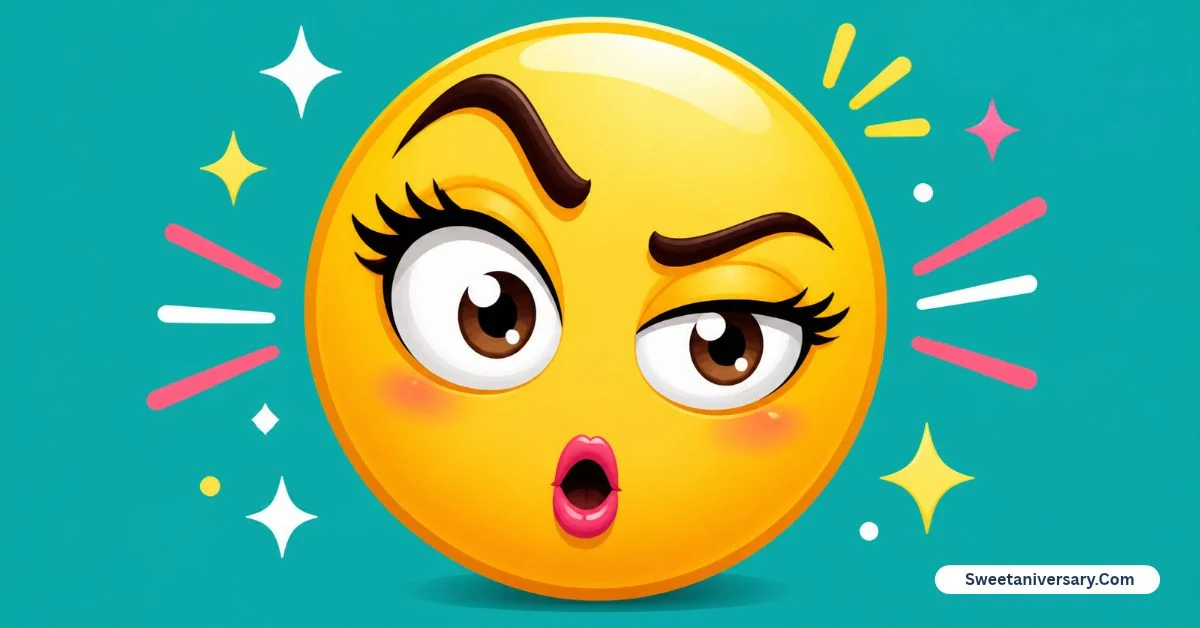
One eyebrow up, a thousand questions — 🤨 is the face that quietly says, “Really? Go on, explain that.”
My friend Zara once texted our group chat, “Studied all night, exam is going to be easy.” This was thirty minutes after she had posted a story from a rooftop party, timestamped 2 a.m. Nobody typed a single word back.
Six of us, one after another, replied with the exact same emoji: 🤨. She sent back “okay, fair” and a laughing emoji.
That tiny raised brow did all the talking — it called her out, teased her, and made everyone laugh without a hint of real anger.
If you have ever wanted an emoji that questions, doubts, and teases at the same time, this is the one. Here is its full meaning, the best moments to send it, and how to avoid it backfiring.
What does raised eyebrow emoji mean?
The raised eyebrow emoji 🤨, officially called “Face with Raised Eyebrow,” joined the emoji keyboard in 2017.
One brow sits high while the other stays flat, the mouth is a straight, unimpressed line — the universal human expression for I am skeptical, and I am listening, but you have not convinced me yet.
Many people compare it to Dwayne “The Rock” Johnson’s famous eyebrow raise, which turned the gesture into pop-culture shorthand for playful suspicion.
It is often confused with its neighbors, so here is the honest difference:
| Emoji | Feeling | Best moment |
|---|---|---|
| 🤨 | Suspicion, disbelief, “prove it” | A claim that sounds too good to be true |
| 🧐 | Curious inspection | Examining something closely, fancy detective mood |
| 😒 | Annoyed, unimpressed | Something genuinely irritated you |
| 🙄 | Eye-roll sarcasm | Obvious nonsense you will not dignify |
| 🤔 | Thinking it over | You are honestly deciding |
Use 🤨 when you doubt but are still entertained. It is a raised brow, not a slammed door.
How to use raised eyebrow emojis
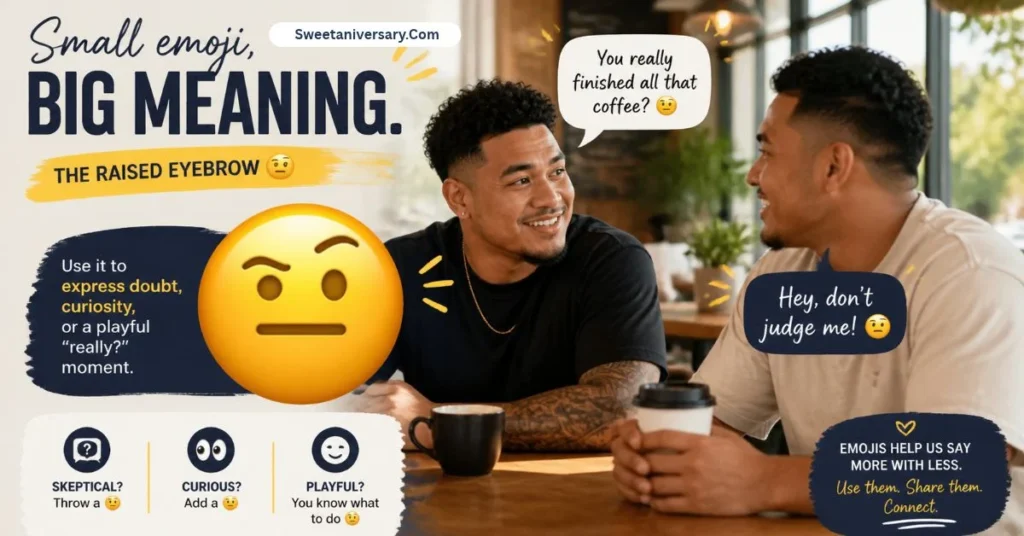
- Calling out a suspicious story. “I definitely did not eat your fries 🤨” — wait, that is the sender’s face at you. Reply: 🤨 and let the silence work.
- Reacting to unbelievable news. A headline so wild it cannot be true gets a lone 🤨 — no caption needed.
- Gentle teasing between friends. “You? Woke up at 5 a.m.? Voluntarily? 🤨”
- Buying time in an argument. Instead of firing back, 🤨 says “that logic has holes” without escalating.
- Reacting to your own luck. “Found money in my old jacket 🤨✨ suspicious but accepted.”
Keep it away from serious moments. A 🤨 under bad news or an apology reads as cold mockery, and that is rarely what you want.
Best emoji combinations for copy paste
- 🤨🧐 — escalating the investigation
- 🤨👀 — suspicious side-eye
- 🤨📸 — caught in the act
- 🤨🤔 — doubting while deciding
- 🤨💀 — the claim is so bad it died on arrival
- 🤨🫵 — pointing right at the suspect
- 🤨⁉️ — demanding an explanation
- 🤨🍟 — for food thieves and fry crimes
- 🕵️🤨🔍 — full detective mode
- 🤨👉🚪 — “the story has left the building”
My group chat’s signature move is 🤨📸 after someone gets caught contradicting their own story. Devastating every time.
Aesthetic emoji ideas for social media
🤨 thrives in reaction culture. Meme pages pair it with screenshots of outrageous takes, captioned only “🤨” — and the comment section does the rest. On Ticktock, creators freeze on their own raised-brow face and let the emoji carry the punchline of “things that make you go 🤨” videos.
For captions, it works as dry punctuation: “He said he’d be five minutes. That was an hour ago 🤨” outperforms a paragraph of complaint. In quote-posts and replies on X, a single 🤨 is the minimalist clap-back — it questions without ranting.
Streamers have adopted it in chat culture too, where spamming 🤨 during a suspicious game-play moment signals the whole audience doubts what they just saw, all at once.
If your brand of humor is dry and observant, 🤨 can even anchor your bio: “professional eyebrow raiser 🤨” says more about your personality than a list of adjectives.
Common problems and solutions
Problem: It looks angrier on some phones. Samsung and older Android versions draw 🤨 with a harsher, more judgmental slant, so your playful doubt may land as real annoyance. Solution: add a softener — 🤨😂 or a word or two — when messaging across platforms.
Problem: It feels disrespectful to elders or bosses. A raised brow at your manager’s plan, even as a joke, can read as insubordination. Solution: keep 🤨 for friends and peers; in work chats, ask the question with actual words.
Problem: People mix it up with 🧐. The monocle face means curious examination, not suspicion. Solution: if you mean doubt, use 🤨; if you mean “let me look closer,” 🧐 is your face.
Problem: On small screens the brow is barely visible. In a fast-scrolling chat, 🤨 can blur into a neutral face. Solution: pair it with 👀 or ⁉️ to make the skepticism impossible to miss.
Trending emoji usage in 2026
In 2026, 🤨 has become the default “receipts, please” reaction. Fact-check culture runs on it: dubious claims in group chats, fan forums, and comment sections get ratio’d with walls of raised brows before anyone even types a rebuttal.
It also rides the “caught in CK” wave — paired with 📸, it is the emoji of being exposed by your own posts, exactly like my friend Zara.
Streamers and escorts chats pushed it further this year, using 🤨 floods to vote “suspicious play” in real time.
And in a quieter trend, people use it on their own posts self-deprecatingly — “my bank account after concert tickets 🤨” — turning the brow inward. Skepticism, it turns out, is the most relatable emotion on the internet right now.
FAQs
What does 🤨 mean when someone sends it to you?
It means they doubt what you said and are waiting for an explanation. It is usually playful, not hostile — a raised brow, not an accusation.
Is the raised eyebrow emoji rude?
Between friends, no — it is teasing. Sent to a boss, teacher, or upset person, it can feel dismissive, so context decides.
What is the difference between 🤨 and 🧐?
🤨 is suspicion — “I don’t believe you.” 🧐 is curiosity — “let me examine this closely.” One doubts; the other inspects.
How do I find 🤨 on my keyboard?
Open the emoji keyboard, go to the faces section, or type “raised eyebrow” in the emoji search bar. On desktop, copy 🤨 from this page.
When did the raised eyebrow emoji come out?
It arrived in 2017 with Unicode 10, alongside other expressive faces, and quickly became a favorite reaction emoji.
Conclusion:
The raised eyebrow emoji 🤨 is the perfect way to express doubt, curiosity, suspicion, or a playful reaction without saying too much.
Whether you’re replying to a confusing message, reacting to a surprising statement, creating funny memes, or sharing Instagram captions and Ticktock comments, this expressive emoji adds personality to every conversation.
Looking for the best raised eyebrow emoji combinations to copy and paste? 🤨✨ Explore our collection of funny emoji combos, creative captions, and relatable reactions to make your posts stand out.
Choose your favorite combinations, express your mood, and let your emoji do the talking! 😂📱